
CBT Therapy for Health Anxiety: What to Expect From Treatment
Summary: Health anxiety involves persistent worry about having or developing a serious illness, often driving repeated checking, reassurance-seeking, or avoidance of anything health-related. CBT Therapy is one of the most well-evidenced treatments for it. This article walks through what treatment actually involves, from understanding the anxiety cycle to reducing safety behaviours and building tolerance for uncertainty, along with how long it typically takes and what to expect along the way.
Health anxiety, sometimes called illness anxiety, is more than the occasional worry about symptoms. It’s a persistent, often exhausting cycle of checking, researching, and reassurance-seeking that can take over daily life. The good news is that health anxiety responds particularly well to CBT Therapy (Cognitive Behavioural Therapy). Here’s what treatment actually looks like, step by step.

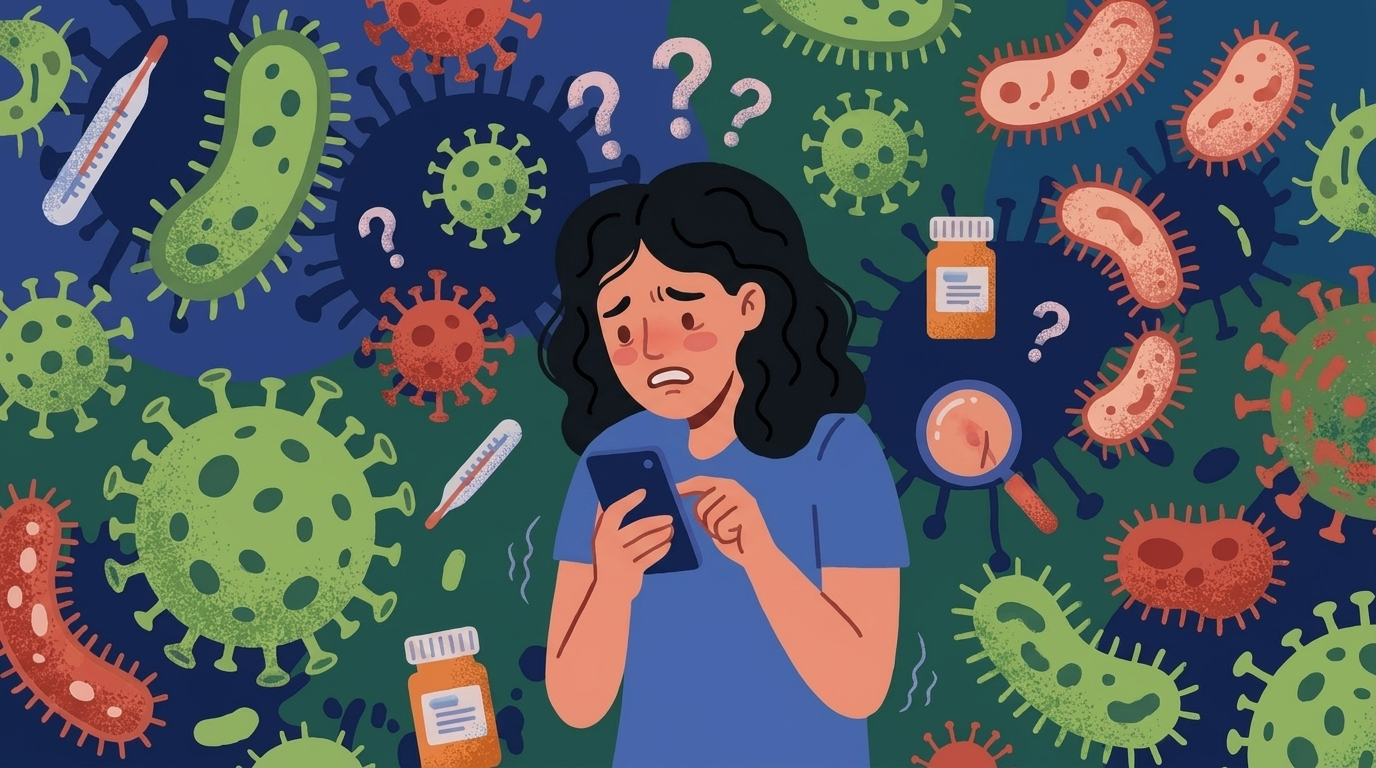
Common diagnostic tests ruled out—this artwork highlights the challenge of identifying illness amid overlapping symptoms and healthcare uncertainty.
What Is Health Anxiety, Exactly?
Health anxiety involves an ongoing preoccupation with having or developing a serious illness, even when medical reassurance says otherwise. It often shows up as frequent body-checking, repeated doctor visits, excessive symptom-searching online, or, in some cases, complete avoidance of anything health-related out of fear of what might be found. Unlike a one-off worry after a strange symptom, health anxiety tends to persist and often gets worse the more it’s checked or researched.
Why CBT Therapy Works for Health Anxiety
CBT Therapy is one of the most well-evidenced treatments for health anxiety because it directly targets the mechanisms that keep the cycle going: catastrophic thinking about symptoms, safety behaviours like checking or seeking reassurance, and avoidance. Rather than trying to convince you that nothing is wrong, CBT Therapy helps you understand why your mind and body respond to uncertainty the way they do, and builds practical skills to break the cycle.
What Happens in Treatment: A Step-by-Step Overview
1. Assessment and formulation. Your first sessions focus on understanding your specific pattern: what triggers the worry, what you do in response (checking, researching, avoiding), and how that response is keeping the anxiety going. Your CBT therapist will work with you to build a shared picture, often called a formulation, that maps out this cycle.
2. Psychoeducation. You’ll learn how anxiety affects the body, why normal physical sensations can feel alarming, and why checking or reassurance-seeking tends to make health anxiety worse rather than better in the long run, even though it feels helpful in the moment.
3. Identifying and challenging thought patterns. Health anxiety often involves specific thinking patterns, such as catastrophising a symptom or overestimating the likelihood of serious illness. CBT Therapy teaches you to notice these thoughts and test them against the evidence, rather than treating them as fact.
4. Reducing safety behaviours. This is often the most challenging but most effective part of treatment. Gradually cutting back on checking, googling symptoms, or seeking reassurance helps break the cycle that keeps anxiety alive, even though it can feel uncomfortable at first.
5. Graded exposure. Where avoidance has crept in, for example avoiding medical appointments, exercise, or certain body sensations, a CBT therapist will help you gradually and safely face these situations, building tolerance for uncertainty over time.
6. Relapse prevention. Toward the end of treatment, sessions focus on consolidating what you’ve learned and building a plan for managing flare-ups, since health anxiety can resurface at times of stress or uncertainty.
How Long Does Treatment Take?
CBT Therapy for health anxiety is typically a structured, time-limited treatment, often somewhere between 8 and 20 sessions depending on severity and how long the difficulty has been present. It’s considered a short-term therapy compared to some other approaches, with a clear beginning, middle, and end, and measurable goals along the way.
What to Expect Emotionally
It’s common to feel some discomfort during treatment, particularly when reducing checking behaviours or facing avoided situations. This is a normal and expected part of the process, not a sign that therapy isn’t working. A good CBT therapist will pace this gradually and won’t push you faster than you’re ready for. Many people notice a meaningful reduction in symptoms partway through treatment, well before it fully concludes.
Is CBT Therapy the Right Fit for You?
CBT Therapy tends to suit people who want a structured, practical approach with clear techniques to practise between sessions. If your health anxiety is closely tied to a specific past experience, such as a frightening diagnosis or bereavement, a CBT therapist may also draw on other approaches alongside CBT Therapy. A good first session should involve a conversation about what’s driving your anxiety and whether CBT Therapy, or a blend of approaches, is the right starting point.
Frequently Asked Questions
Is health anxiety the same as hypochondria?
“Hypochondria” is an older, informal term that’s largely been replaced by “health anxiety” or “illness anxiety disorder” in clinical settings, partly because it’s often used dismissively. Clinically, they describe the same core pattern: persistent worry about serious illness despite medical reassurance.
Will my CBT therapist tell me my symptoms definitely aren’t serious?
No, and this is actually an important part of treatment. CBT Therapy for health anxiety isn’t about reassurance, since reassurance tends to feed the cycle rather than break it. Instead, a CBT therapist will help you build tolerance for medical uncertainty itself, which is a more lasting solution than being told everything is fine.
Can health anxiety develop after a real health scare?
Yes, it’s common for health anxiety to develop or worsen after a genuine medical event, a frightening diagnosis, a health scare involving a family member, or even a period of serious illness. In these cases, a CBT therapist may draw on approaches alongside CBT Therapy to address the specific experience that triggered it.
Do I need to stop googling my symptoms completely?
Not necessarily all at once. Treatment usually involves gradually reducing symptom-searching as part of tackling safety behaviours, rather than requiring an abrupt stop. Your CBT therapist will help you approach this at a manageable pace.
Can health anxiety come back after treatment ends?
It can, particularly during stressful periods or after another health-related trigger. This is why relapse prevention is built into treatment, so you leave with a clear plan for recognising early signs and applying what you’ve learned if symptoms start to resurface.
Not Sure If This Is What You’re Experiencing?
If you’re not sure whether what you’re feeling fits health anxiety or something else, our Mental Health Symptom Compass can help you think it through. Simply describe what you’re experiencing, and it will suggest therapy directions worth exploring. Try the Symptom Compass →
About the Author
This article was written and reviewed by Alistair Bond, a Senior CBT Therapist at the CBT Clinic London. Alistair is fully accredited with the BABCP (British Association for Behavioural and Cognitive Psychotherapies) and has 25 years of experience working as a CBT therapist, including 13 years within the NHS before establishing his private practice. His clinical experience spans a wide range of anxiety, mood, and trauma-related difficulties, giving him a grounded, evidence-based perspective on what actually works in treatment.
Related Posts

OCD Therapy CBT Private Clinic East London
OCD Therapy CBT Private Clinic East London Obsessive-Compulsive Disorder or OCD...

Pure O – All The Facts You Need To Know
Pure O - All The Facts You Need To Know Purely Obsessional OCD, or Pure O as...

Online CBT Therapy – Everything You Need To Know
Online CBT Therapy – Everything You Need To Know Online CBT Therapy is the...

Corona Virus Anxiety London – Free Mindfulness Therapy Online Every Wednesday
Right now (April 2020) we are dealing with a very unusual, disruptive and...